
Paid-entry jewellery trade shows liable to entertainment duty, Supreme Court rules
Top court dismisses GJEPC appeal, holding that IIJS events with paid entry count as entertainment under the Bombay Entertainments Duty Act, 1923.
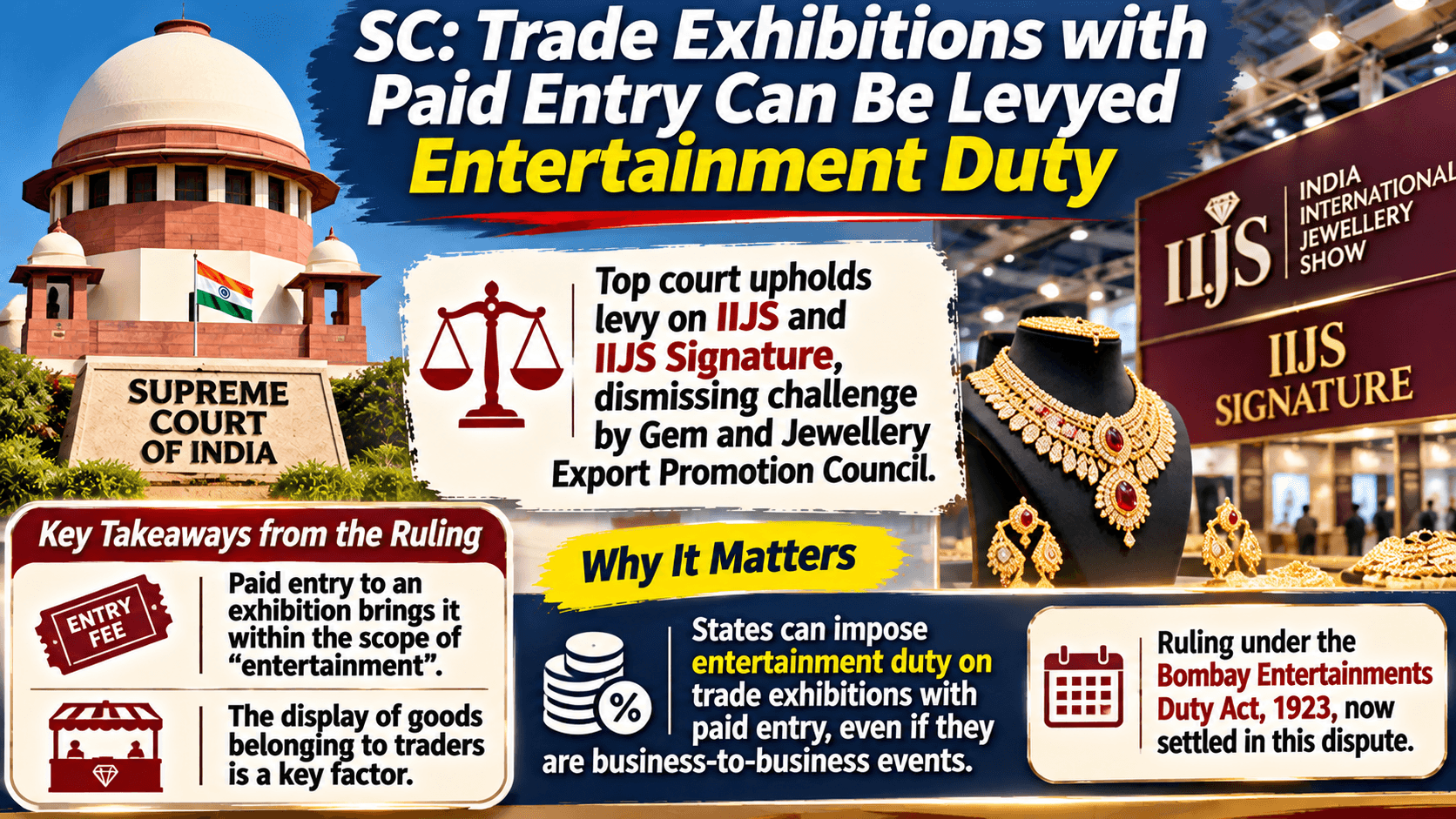
Organisers of trade exhibitions that charge visitors for entry can be made to pay entertainment duty to the state, the Supreme Court ruled on Thursday, dismissing a challenge by the Gem and Jewellery Export Promotion Council to the levy on its flagship annual shows.
The verdict concerns the India International Jewellery Show (IIJS) and IIJS Signature, both organised by the council. A bench of Justices S V Bhatti and N V Anjaria upheld an earlier decision of the Bombay High Court, which had found that such paid exhibitions come within the meaning of entertainment under the Bombay Entertainments Duty Act, 1923.
What the court decided
The central question before the bench was whether an event meant purely for business dealings between traders could still be treated as entertainment for tax purposes. The court answered in the affirmative.
According to the bench, two features were decisive:
- Visitors to IIJS and IIJS Signature are admitted only after paying a fee.
- The exhibitions display goods belonging to the participating traders.
Once entry is conditional on payment, the court said, the business-to-business character of the event does not remove it from the scope of entertainment as defined in the 1923 law.
The council's challenge
The Gem and Jewellery Export Promotion Council had appealed against the levy imposed on its annual events. Its appeal to the Supreme Court followed the Bombay High Court ruling against it. With the top court now affirming that ruling, the council's challenge stands rejected.
Why the ruling matters
The judgment clarifies that states have the power to impose entertainment duty on trade exhibitions where entry is paid, regardless of whether the audience consists of businesses rather than the general public. The decision is directly relevant to the gems and jewellery sector's major trade events, and its reasoning rests on the fee-based admission and the showcasing of merchandise rather than on the nature of the transactions that take place inside.
The ruling was delivered under the Bombay Entertainments Duty Act, 1923, and the bench's interpretation of the term entertainment under that statute now holds as the settled position in this dispute.