
AAP's Goa story: six per cent of the vote, and a quiet lifeline for the BJP
From 39 candidates and zero seats in 2017, to serial exits and a 1-of-42 wipeout in the 2024 Zilla Panchayat polls — the record of a splinter force.
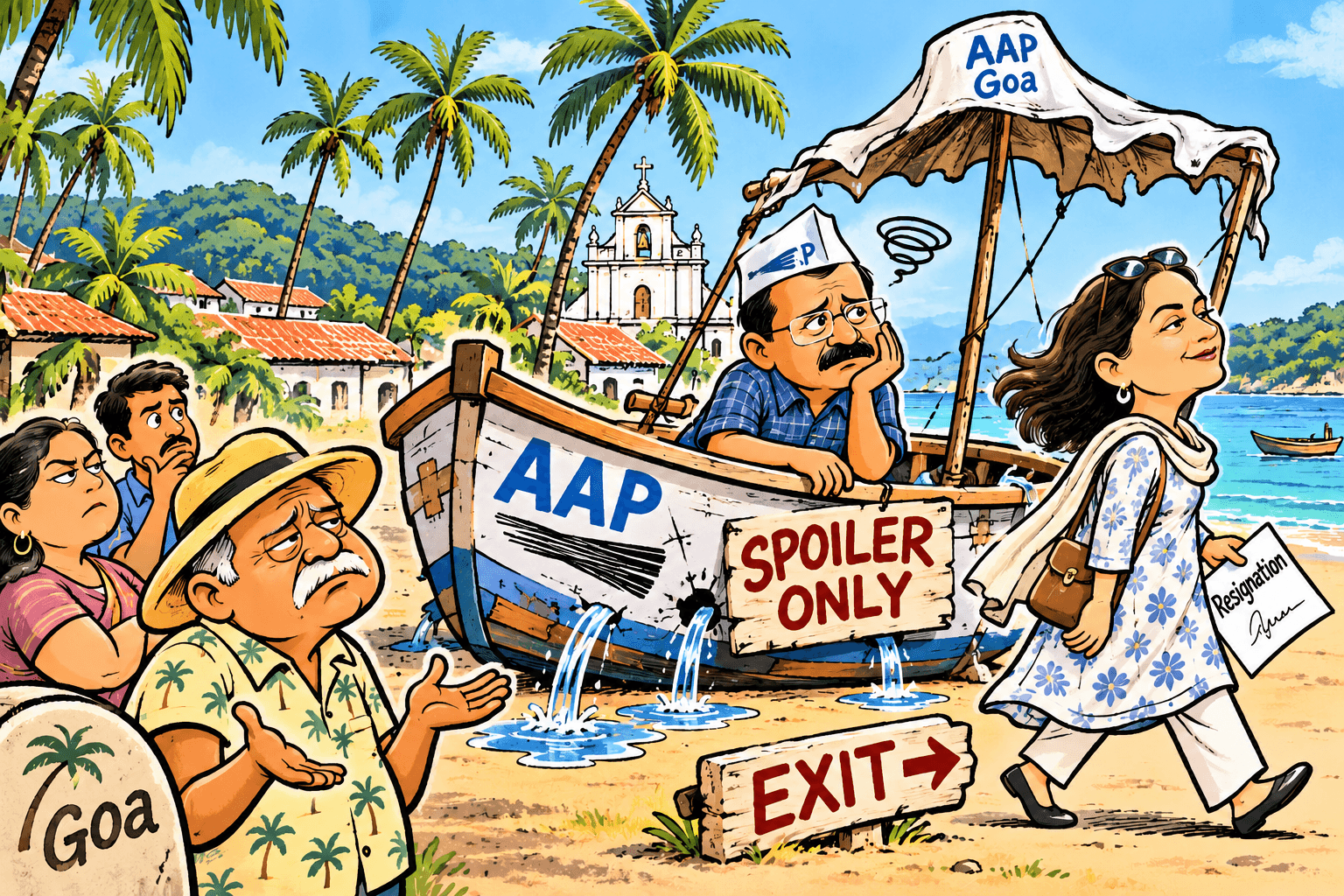
Chronology of the Aam Aadmi Party's organisational collapse in Goa — a chronology which, when placed alongside the party's electoral record, raises a harder question. Is AAP in Goa a political alternative, or is it, functionally, a vote-splitting apparatus that returns the ruling BJP to power with every cycle?
2017: 39 candidates, zero seats
The Aam Aadmi Party contested its first Goa Assembly election in February 2017, fielding candidates in 39 of the state's 40 constituencies. The results, as recorded by Scroll.in and IndiaVotes, were unambiguous: the party won zero seats on a 6.34 per cent vote share. Elvis Gomes, the former bureaucrat projected as AAP's chief ministerial candidate, finished fourth in Cuncolim.
On its debut, the party collected one in sixteen of all votes cast in the state — without returning a single legislator. In a 40-seat house where governments routinely form on wafer-thin margins, that is the signature of a vote-splitter.
2022: Two MLAs, and the CM candidate's own loss
Five years later, AAP tried again. It contested 39 seats and this time returned two MLAs — Venzy Viegas from Benaulim and Cruz Silva from Velim — on a 6.77 per cent vote share, according to the Election Commission tally carried by BOOM and the state assembly record on Wikipedia. The BJP won 20 seats and returned to office under Chief Minister Pramod Sawant; the Congress managed 11.
The most instructive contest, however, was the one AAP's own chief ministerial candidate lost. In the St. Cruz constituency in North Goa, Congress' Rodolfo Fernandes defeated the BJP's Antonio Fernandes by a margin of 2,464 votes — 8,841 to 6,377, as The Quint and Asianet News reported. Amit Palekar, AAP's CM face, finished third with 4,098 votes. The numbers speak for themselves: the AAP candidate received more votes than the gap between the winner and the runner-up.
St. Cruz did not flip to the BJP in 2022. But across 39 contested constituencies, the arithmetic of a 6-to-7 per cent third-party vote share — in a state where single-digit margins are routine — is the arithmetic of an opposition handicap.
The 2024 Zilla Panchayat wipeout
If the 2022 Assembly result was mixed, the December 2024 Zilla Panchayat polls were a rout. The Aam Aadmi Party contested 42 of the 50 Zilla Panchayat seats across North and South Goa. It won one. The Print and ETV Bharat, both covering the aftermath, reported that AAP managed "just one of the 42 seats it contested in the December 20 elections". The BJP took 30 and the Congress eight.
What made the collapse personal was the fate of the party's state president. Amit Palekar polled 220 votes in his own home ground. On December 29, 2024, two days after the Zilla Panchayat verdict, Deccan Herald reported that the AAP central leadership had removed Palekar from his post.
January 2025: the organisation implodes
The removal triggered a wider exit. On January 5, 2025, The Federal and The Print reported that Palekar, acting state chief Shrikrishna Parab, and three other office-bearers had resigned from the party's primary membership. Parab told reporters he was quitting "to register his disapproval of the way Palekar was removed".
In October 2025, the state working president Rajesh Kalangutkar followed them out, resigning both from his post and from the party's primary membership. Kalangutkar's stated reason, as published by The Federal and Goemkarponn, was Kejriwal's repeated public pronouncements that AAP would contest the Goa polls alone. Opposition unity, in Kalangutkar's view, was being discarded.
In his own account to Deccan Herald in February 2025, Amit Palekar — the former CM candidate, since outside the party — said AAP and Congress "should have contested [the Delhi assembly] polls together". Palekar's words, offered about a different election, apply equally to Goa.
The arithmetic the opposition cannot ignore
Goa elects 40 legislators across constituencies that typically turn on two-to-five-thousand-vote margins. In the 2022 Benaulim contest — the one AAP narrowly won — Venzy Viegas defeated Churchill Alemao, standing on a Trinamool Congress ticket, by around 1,200 votes, as the Benaulim constituency page on Wikipedia records. In a state where a 1,200-vote swing changes an MLA, a statewide 6-to-7 per cent third-party vote share is not a rounding error. It is a structural feature of every opposition loss.
Two election cycles have now produced a consistent pattern. AAP enters Goa with national-level rhetoric and a state-level organisation that collapses within months of each contest. In 2017, that cost the opposition a share of the anti-incumbency vote without returning a single seat. In 2022, it returned two AAP MLAs while the BJP comfortably crossed the halfway mark. In the 2024 Zilla Panchayat polls, it returned almost nothing at all.
Venzy Viegas and Cruz Silva, the two sitting AAP MLAs, have so far rebuffed defection rumours. In reports carried by Herald Goa and The Goan, Viegas has maintained that AAP remains the credible anti-BJP alternative in the state. Both MLAs did, however, back the Congress candidate for Assembly Speaker before publicly declaring the end of any India-bloc cooperation — a stance that leaves the two opposition blocs fragmented going into the 2027 Assembly cycle.
What to watch
The question before Goan voters in 2027 is not whether the Aam Aadmi Party deserves another look. It is whether the pattern of the last decade — ambitious national party arrives, wins no mandate, exits the organisation, retains only a handful of personalities — serves the democratic purpose the opposition is there to serve. On the record available, it has not. It has, on the available arithmetic, served only one party, and that party is in government.
For a bipolar electorate with genuine anti-incumbency, the mathematics of a third-party vote-share is the mathematics of a lifeline to the incumbent. Coutinho's September 2023 letter was an early line in that story. The January 2025 mass resignation was a middle chapter. The 2027 Assembly campaign will decide whether Goan voters read the ending differently.